Thursday, April 23, 2020

Algorithmic Recipies


Grilled/baked/airfried veggy / protein
+
Stir fried veggies / fruit / protein
+
Soy sauce / other savory sauces (magi, bragg's liquuid aminos, anchovy sauces like nouc mam; Worcestershire)
+
Spices/seasonings
+
Starch base of your choice (rice, pasta noodles, mashed potatoes, fries, etc.)


This'll serve you and everyone you love well.

Play with rinds and peels too--orange, banana, mango all have edible skins so clean those thoroughly, chop and cook as appropriate.

Thursday, December 25, 2014

Tastes like French Colonialism!

Slice of Brie cheese + Club Cracker topped with Sriracha.

Saturday, September 6, 2014

Thunky Pancakes: a very southeastern culinary jam


 Thick+chunky pancake batter = thunky

Made this in the DC region with my friend, Danny makes this an southeast of southeast Michigan culinary adventure.

I'm forgetting the exact ingredients now--highlights included using:
+ create a mix of almond meal, flax seed, walnuts, and some other substance to form the
+ a touch of vanilla, cinnamon, and all spice
+ possibly soy or almond milk and water

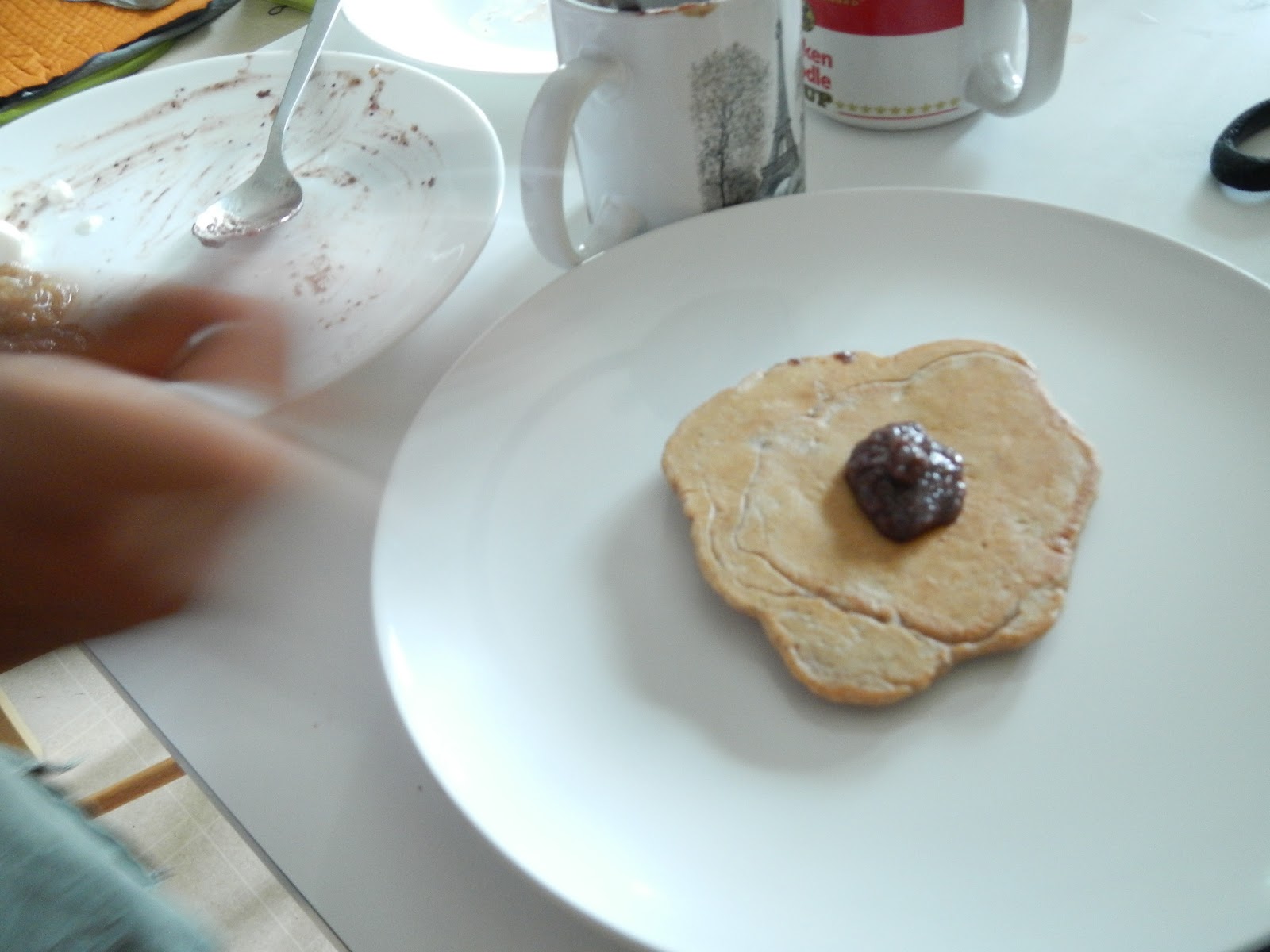
This made an incredibly substantive mix which literally would "thunk" on the pan. One pancake is so dense it makes a satisfying breakfast in itself.


Ready to flip!


We'd later top it with a smoothie of blueberries, apple, and other fruits. Plus either ice cream or yogurt.


Not pictured: we literally sketched out our plans before topping the pancakes

Mine (blueberry-banana-apple-spinach center mass, apple-banana blend radiating, topped with ice cream & almonds + apple slice)


For our first trial, Danny went all out with the blended fruits, same ingredients, hearty proportions.

Sunday, October 27, 2013

Sourcing a pie

I asked my friend where the rest of the ingredients came from:

"I love when my food is largely locally sourced but other than the fruit that pie sadly wasn't.  The berries were from the UP.  Flour was organic King Arthur. Sugar and butter were from the grocery store as was the lemon juice."


In the U.S., the state of Michigan ranks second in agricultural diversity only to the state of California. It’s possible that the sugar came from beets, and beets are a substantial crop here in Michigan. It’s possible the butter could have come from Michigan as well. The salt-might have come from Detroit—an ocean once covered the state and though few people know it, salt mining remains an active industry in Detroit. And while I don’t know where King Arthur flour comes from (perhaps Kansas?), Michigan also grows varieties of wheat suitable for pastries and cakes.
Aside from the lemon (which likely comes from the state of Florida), Michigan has the ability to provide most of what we need for a pie made from rather local ingredients. Though there are people passionate about getting good food that supports their local communities, it’s a challenge even for us to know where it all comes from.
Salt could have come from Detroit:
Flour--maybe from Kansas? King Arthur Flour

...

I wound up adapting (and finishing!) this to introduce myself as a strategist for ISMOTION's educational programs--go read it there!!! http://ismotion.co/introducing-ian-with-ingredients-for-adventure/
EDIT: Had to change the link as the company website changed and we lost all the embedded links and many of the images too. :-( On the bright side, I remember one link: if sound could uniformly represent taste for everyone, I'm pretty sure it the pie would sound like the song embedded.

Wednesday, September 25, 2013

"Wasabi is not hot, if..."

I just tried a piece of chili cherry dark chocolate, and a Japanese co-worker who didn't like hot flavors, and thus the chocolate because it had hot chilies in it said:

"Wasabi is not hot."

 We were surprised, as he certainly had wasabi before.  We asked him to clarify.


"if chili is defined as hot, wasabi is a different sensation."

I asked if it's because of the way wasabi attacks the senses, and he affirmed the distinction.  I've then concluded this:

Wasabi is not hot, it's malicious.

Thursday, September 12, 2013

Sweet summer pies & a snippet of scientific inquiry!

This summer's been filled with memorable and very heartening pies indeed!

First: A generous gesture of kindness 
Blueberry Pie at a technical conference
Kindness in the form of an Amish blueberry pie gifted to me by a duo of Kansas professors.  We shared a dorm at Alfred State College in upstate New York for a technical conference on sustainability in higher education.  As I've written elsewhere, most people I know of suit up to power network, I treat it like a sport.  But the people there savored the good conversations that arose from the event and over meals sourced from the campus and nearby farms.  It must have been the most humane sustainability conference I've ever attended (I even titled a new viola tune of mine and wrote an essay called "emotive mechanics" thanks to the experience).

While the pie was way too sugary, diabetes by the first bite, the story and trip made it worthwhile: they bought the pie from a stand on the side of a country road run by two Amish girls, had a slice during the conference (no one had utensils available) and gave it to me before they departed for the airport.  For me, the pie reaffirms the value of a personable story.

Second: Wondrous pie
Huckleberry Pie--the finest pie I've had yet & a taste of curiosity
If sound could represent taste, I'm pretty sure it would be akin to the joys heard in this song (if you're a synasthesiac--where you taste sounds, let me know if it's a good approximation).


Just the right sweetness from the berries and sensible use of sugar, with a crispy salted crust and topped with delectable crumbles made a wonderful counterpoint in texture and taste.  Best of all, made by a friend to enjoy at the end of an excellent meal with her family!


Huckleberries are new to me--I thought they'd be a fruit of the South thanks to Samuel Clemens' (AKA Mark Twain's) book Huckleberry Finn, and the accent of Huckleberry Hound, the cartoon.  My friend picked these fresh from a farm in the Upper Peninsula (before freezing them for safe keeping).  Even her father was curious about their origin and distinguishing features.  We speculated that blueberries were a commercialized agricultural cultivar of the huckleberry.  Our reasoning:

1) blueberries tend to be larger,
and
2) huckleberries tend to be sweeter.

To substantiate that line of thought, the best fruit I've ever had was from foraging a wild strawberry native to Michigan before a storm in May at the University of Michigan-Dearborn's Environmental Interpretive Center (even captured the moment in shaky video!).  If you've seen them (or watched the video) commercial strawberries are huge, and frequently nearly flavorless.

After consultation with whatever scientific consensus I could find through an un-scholarly and brief google search, I learned that our joint hypothesis was incorrect.  Huckleberries are a different species altogether, and their ranges differ too (I'm guessing we ate the fruits of Vaccinium membranaceum).

In any case, the findings have no bearing on how much I enjoyed sharing the pie and evening with everyone at a table in Traverse City.

Monday, June 24, 2013

Hotel Cuisine: Ironed toast? Hardboiled egg.

In the Windy City's downtown, everything's expensive. That's why I got groceries as soon as I arrived to make my own meals.  Chicago's notorious for charging steep prices.  So too are their hotels.  On my first day at the AWMA conference, I decided to partake in the breakfast buffet at the Hyatt.  During a luxurious meal, I thought to myself "how wonderful that this conference includes breakfast!"  And then I was approached by a waiter with a $26 bill.

So, the plan for the week: get groceries, cook my own food--in the hotel!

Edit (commentary from the video):
I've accomplished hardboiled and poached eggs.

Eggs were microwaved for about 4 minutes. The orange had no effect on the flavor. I had concerns about sparking, so I added orange peels to the mix: http://www.youtube.com/watch?v=DrY0aC...
The concerns about sparks came from rusty memory having read this: http://www.madsci.org/posts/archives/...

I didn't have time to do the toast the next day. I don't adapt to professional conference schedules as quickly as I hope sometimes...

Sunday, May 5, 2013

Local sweetness

I'll dare say pure maple syrup can work better than honey in a tea/herbal brew.  Something about the woody notes of the syrup mingling with a good minty warm brew makes it a success.

I've thought about maple syrup (less so birch syrup, but that too) as a regional source of sugar instead of having cane sugar, honey, or corn syrup.  I wondered: why don't we take pride in having Michigan maple syrup in our drinks/baking/cooking?

I suspect it's really challenging to obtain since you need about 40 gallons of maple sap to make 1 gallon of maple syrup.  How do I know? Partake in making maple syrup at UM-Dearborn during the late winter/early spring!


Edit: In the interest of sustainability and food systems, I wound up posting a question on Quora about what source of sugar takes the least energy to create.  You can check it out here: http://www.quora.com/Sustainable-Agriculture/Which-are-least-energy-intensive-for-producing-sugar-sugar-cane-beets-corn-maple-birch-or-honey

The biggest problem I can see with asking that kind of question the way I did is that people are likely going to look at it as a matter of industrial optimization--how can we get the most sugar with the least amount of energy/water.  While that's not the intent, I figured it would be useful for others to know what goes into the production/procurement process of our sugars.  For anyone curious, there's a relatively standardized technique called "life cycle analysis".  In concepts of environmentalism, we had to perform embodied/embedded energy assessments.  In essence, ask the question: what went into making, processing, and transporting whatever product you're using?  How much energy did it take to make? To process? To transport? etc. and then sum it all up.  Similar idea.

If you've got answers, or just want to research with me, I'd be really interested in seeing them!

Tuesday, March 5, 2013

Humm...us.... that was satisfying!

I made hand-mashed hummus, and it was rather satisfactory.

Not sure what I did with the photos, but it was good.  Here's a less flattering photo of my attempt at a friend's house:
Not quite done with the mashing, you can use a heavy
spoon or ladle instead of a potato masher if that suits you.


If you mash it, use less olive oil, and leave some coarseness from the beans so that it's less smooth it becomes a good, hearty paste.

Hummus:

1 can of garbanzo beans (chickpeas)
1/4 - 1/2 cup of olive oil
lemon
cayenne pepper
caribbean jerk seasoning
drops/drizzle of liquid mesquite smoke

If you're really wild, you can add a drizzle of maple syrup as well!

Saturday, February 2, 2013

Wonton folding technique

I didn't realize there were region-specific styles for folding wonton wrappers.  It's almost on par with endeavors in origami, except with food.  After much googling, I found what might be the best video so far:


If you even think you hear the phrase "will generate much happiness" (I don't think she ever said it in this video, but somehow I recall hearing it) and "secret ingredient", it's almost definitely the real deal.

Side note about the video:  her chopping/knife wielding technique would benefit from a few things: 
1) modify the grip so that the index finger wraps onto part of the side of the blade surface 
(yields better grip/leverage, interestingly, this is similar to the grip I use to hold the bow of violins and violas too)
2) use a forward/backward rocking motion with the chef's knife as you slice/chop rather than chopping straight up and down
3) angle the green onions so that slices are diagonal (which should release more flavor--see the great diagonal cut/microbiology argument I posed in a previous year)
Someday I'll figure out how to make a variation for vegetarian and vegan friends...

Saturday, October 27, 2012

Tea and yum

Running short on honey at home, my dad ventured into combining real maple syrup with green tea.  I did the same and it was wondiferous!  I realized maple syrup is a good seasonal choice (typically for early new-year/spring months), but if you ration it out, it can come to play just in time for oncoming colder weather as well.

I also noticed that baileys and tea might work well:  if people are pleased to try milk or cream with their tea, why not enjoy it with a bit of Irish cream?  Especially in the winter months, I think it makes sense--for those living in the temperate regions, the extra calories and fermented sweetness of an alcohol in a hot beverage are probably a welcome way to prepare for the colder months.

This may be a sacrilegious act, but I'll try it someday just to see what happens...

Tuesday, July 10, 2012

Resourceful cooks

Bravo to the creators of these three fine culinary ideas.

The crafty and resourceful cooks featured in these videos or whomever it is that came up with the mug cake undoubtedly deserve substantial applause.  The first and last are my favorites though I've never tried their recipes.

I can especially relate to the last individual (George Egg) as I recall straining pasta using a snow sled and considered making penne pasta using a coffee maker in the winter of January 2010 while staying at a cabin in Waterloo Recreational State Park with several fellows.  That was also the first time we browsed "wild" (more likely feral) rose hips too.  If I can find the pictures from that outing I'll try to post them.  It's the finest demonstration of  McGuyver caliber culinary work I've ever seen.

The list:

Friday, June 29, 2012

Overdoing the good stuff

I didn't think it was possible to overdo the good stuff until it happened today.


After finishing a calculus exam and a foreign language test, I came home to an empty apartment. Awaiting me: an array of wonderful ingredients and opportunities.
  • an assortment of six bottles of fine craft beers ready for an experiment
  • freshly picked feral baby garlic from the fringe of the UM-Dearborn organic gardens
  • avocados ($1 per fruit)
  • rosemary ($0.99 for a bundle)
  • a "maple salmon kabob" ($5)
  • a bag of "confetti potatoes" (hooray!) ($3)
  • a box of mixed sprouts ($2)
  • a container of salsa ($3)
  • left over bread rolls in the fridge from about a month (perhaps more) ago
  • Neat, garlic from garlic!  Youth on Age!
    In the background:
    The Bean Facts man, Alfred Batshon
    is our kitchen deity.
  • and hot mustard (horseradish mustard) given to me from work by colleagues who ate out at a PF Chang's location


How exciting! I don't recall having so many quality, fancy, and fine ingredients in one place.

Plus, good drink pairings (including non-alcoholic drinks) with food taps into a broader interest of mine:
emergent properties in complex systems. What am I talking about?

Here's the tangent: With anything, we can appreciate something on its own, in complementary company with, or in contrast (counterpoint) with something else. In these instances, it's equivalent to adding one good thing to another.

Sometimes--a very rare and subtle experience for me--two foods together bring out a third sensation. For those who like business buzzwords, this is synergy. For physicists, this is the equivalent of a "constructive wave", when two waves combine to make a bigger wave. To life scientists and complex systems thinkers, this is the emergent property--you discover an outcome that's equivalent to multiplying two things together to get a tremendous result!

It happens a lot in nature and society: simple interactions may aggregate into something very different from what we expected (chemistry comes to mind, which brings us back to the reason for why we taste different things).

Unfortunately (back to the food), I didn't quite get to it. Simmering rosemary in the beer with a drizzle of olive oil worked out remarkably well in the pan as far as I could tell by their aroma.

However, between the salmon, its maple (syrup marinade?) flavoring, and avocado, these very rich and heavy flavors effectively dominated over any potentially subtle emergent qualities (this is the wave cancellation effect for physicists) that arose from the presence of rosemary and the Spicie Nicie ale (I'll say the ale wasn't as exciting as its label made it seem when I tasted it as-is, might have been the batch though). I could have paced my eating differently so that I could enjoy the more delicate flavors first instead too.

In any case, it was a very satisfying meal and I'm always struck by the paradox and phenomenon of luxury when indulging.

I really admire salmon--it's a noble fish (lobsters, though not fish, are also admirable, that's a different story to explain though). In the wild, many will hatch, grow up in fresh water, migrate into the ocean, and then return to fresh water to the place of their birth (found by scent!) to spawn before dying. Fish that do this are called anadromous--their bodies change so that they can adjust between fresh water and salt water. To eat something that works that much for the success of its species demands a lot of respect, and I always wonder if I've given my fair share of effort to merit a meal like that--even if I were the one catching it.

(aside: if ever the opportunity arises and I really needed a fish to survive, the most satisfying way to catch a salmon would have to be with one's own canines, unfortunately my canines might be too smooth for this to be a reality, and salmon are way too powerful to catch in that manner...maybe I'll turn into a bear someday)
Then of course, there's the very real question of privilege and poverty--there's a difference between buying salmon for $5 to enjoy over a few meals versus buying as much sustenance to hold one over for $5--i.e. a jug of milk and loaf of bread can make a difference for a hungry family.

I started eating before I remembered
to take additional photos.  I later
found the mustard and drizzled it on the sprouts.

Tiny note: the garlic was still very young, it fares better in a salad.

I was so hungry I started eating and
forgot about the potatoes until later too.
The potatoes turned out well, they went nicely with the sprouts and mustard. The salsa on the avocado was refreshing too. As good and luxurious as it was overall (even one of these items in a meal is a rare privilege for many people), there was way too much flavor going on at once for my taste buds and brain to figure out. I'd either have to sequence my meal better, or focus on just a few things. I'll call it "strategic eating" when faced with a smorgasbord of fine foods.

Ethical notes, some less appetizing than others:


When purchasing the fish, I was probably the only person who asked the fish vendor where it all came from, but he promptly searched his boxes and bags to find out for me. This salmon came from "Canada", which seems much closer to me than South America or the Pacific Ocean, but for all I know, it could have come from the West Coast. The Montery Bay Aquarium seafood watch has a guide for fish purchasers (see here for salmon) and frequently provides detailed reports on the fishing industry and its environmental impacts.

In retrospect, I don't feel so good about having salmon from ambiguous geographies, and likely won't be one to purchase it in the future.

Avocado comes from afar too.  On its own though, I suspect having several avocados would be better than having a salmon.  It's a plants versus flesh assessment: by default, plants need less resources to exist than do carnivorous things, plus imagine boating out to catch a fish, shipping/flying/trucking it to Michigan... this one was wild-caught, but farmed is almost certainly a more intensive a process when it comes to having people care for the fish and the places they're grown in--fish farmers frequently pack holding pens of fish with more fish than even the fish themselves are used to being around.  It can get messy when you consider what the requisites for making an artificial environment for fish can be--antibiotics, waste, uneaten food, etc.   Ahh, maybe this post's title wasn't overdone with the good stuff after all...

On the bright side, the sprouts came from a place in Michigan that starts with the letter "I", the garlic was definitely local and organic.  

Friday, June 15, 2012

Rum and Sweet Sweet Cereal

Avocado and fresh salsa are an obvious complement worth having with a meal.


Avocado and honey are wonderful together with breakfast, I'd probably enjoy that any day.


Reese's Puffs and a splash of rum are surprisingly enjoyable too, but I'd advise doing so in moderation or for pastry purposes only.


No, I don't drink excessively, I had less than a teaspoonful of rum.  My roommate makes a lot of tinctures and uses a lot of vodka (sometimes rum too) precisely because of their high alcohol content.  Since he keeps all of it atop the fridge, I couldn't resist combining the two.

Reese's puffs fall under what I consider is a category of "dessert cereals"--you can eat part of your complete breakfast, starting with a bland granola/shredded wheat cereal, move on to some heavier fair like eggs and toast, and then finish off with something like Reese's Puffs or Count Chocula.  Voila!  A three course breakfast.  But don't be fooled by the marketing, you can have the sweet cereal at the end of any meal.

For other similar combinations: a touch of Disaronno or Bailey's and ice cream are wonderful too.  I think this affinity for a combination of sweet with grains and alcohol comes from birthday cakes by my mum which were baked with grand mariner when I was much younger.

Sunday, May 20, 2012

On honegar: you're using it wrong?

Honey + Apple Cider Vinegar = Honegar

I helped my roommate make a batch of honegar some full moon or two ago.  He gave me a jar of it, and for too long I avoided using it because 1) I normally don't like things with vinegar 2) I had no idea what to do with it.

Because of premise #1, I refrained from tasting it, and thus continued to not know what I'd do with it.  One day in the recent past I finally gave it a try and got a great kick out of it.

It's really good!  Honegar actually works wonderfully on salads like a vinegairette dressing, to reiterate with what I said elsewhere after looking it up and trying it out: It goes well with spinach-based salad--better than many raspberry vinaigrette dressings. I'd re-name it to Honegrette.


However, it seems to have a terrible reputation.
Time Magazine listed it as one of the worst inventions ever:
http://www.time.com/time/specials/packages/article/0,28804,1991915_1991909_1991907,00.html
Same and these people seem to look at it more like a form of medication than they do as an enjoyable food:
http://fashionsmostwanted.blogspot.com/2010/08/benefits-of-honegar.html

I think its predicament is attributable to poor marketing.

Friday, March 9, 2012

From now on...

From this day forth, it shall be known that I refuse to seek nutritional sustenance from a campus vending machine for the rest of my undergraduate career.

From a disappointing series of events involving planning and time constraints, I forgot to bring/get a proper supper before class today.  This brought me to the vending machine.

The menu:  A bag of planter's peanuts (protein), a "cheese mix" bag (semi-complex carbohydrates] sun chips, pretzels, Doritos, and cheese-its), and apple strudel pop-tarts (they say it has 7 vitamins and minerals!  Don't count on it though, most are synthetic and I'm pretty sure the body has a hard time digesting them in that form) for a total of $2.50.  For this much money, one can get a much more satisfying and nutritious spinach pie at the campus "cafe" (also very likely over-priced at $2.00).

Granted, there are worse dilemmas in the world--I have the privilege of temporary hunger, satiating it to a degree, having food available at home, and am capable of writing about it here.  However, it's remarkable to experience such a swing in attitude and physical performance that's absolutely attributed to nutrition.  It's a definite challenge for one's character (and academic performance too).

Sunday, January 15, 2012

Bachelor baking challenge #2

My last venture with baking resulted in what I've dubbed "Shortbread Boulders"--they were shortbread cookies made for my chemistry lab, I made sure they were gluten-free because one of my classmates had/has Celiac disease (basically, gluten agitates the body enough that the immune system starts attacking  the digestive system).

In mid-December, my neighbor, Bethany, gave us (me, she may have meant to share it with my dad too) a wonderful pot pie.  She's very health conscious, and the pie was made from free-range, organic AND gluten free ingredients.

It was excellent, I ate all of it over the course of two meals and many friends on campus were either amazed that I brought an entire casserole for myself as a lunch, or envious that its contents smelled and looked so very enticing.


About a month later, I've finally resolved to return the casserole with something that meets most of the previous conditions Bethany had set:  I'd make something with granola (relatively gluten free), Mulberry Preserves made by the a few friends of mine in Detroit (they collected and cooked it with the Detroit Asian Youth project, I played music afterward and brought some food for everyone to enjoy).

Mulberry Preserve made by the good people of
the Detroit Asian Youth (AKA DAY project),
the label was designed by Michelle Martinez.
The photo is mine, and the lion looks suspiciously similar to me...

Look beyond the jump for the musings about baking...

Sunday, January 8, 2012

Opa! The science of flaming saganaki?

Yesterday I was at a "Grecian Cafe" in Ann Arbor hungry for something hot like a grilled cheese sandwich.  Few things seemed as hot as flaming fried cheese, so I ordered the saganaki dish, which is flambe'ed in many Coney Islands and Grecian Cafes throughout the U.S. (but particularly in Southeast Michigan).  [Side note:  I think Ann Arbor needs a Coney Island that's open for 24 hours.  If any entrepreneurs read this and do so, I'd gladly become a patron, but I hope I'll get some of the profits, a discount, or a free dish]

Then I wondered:  what in the world makes it so flammable?
Perhaps it's alcohol of some sort, but then I thought--what if there's a certain gas that the cheese releases?  Hmmm!  That would be even more interesting.

Unfortunately, a quick search about the internet suggests a few table spoons of brandy is the real fuel for the flames.

My last pondering about this dish:  why is there never enough bread to go with the cheese?

Friday, January 6, 2012

A twist on falafel

Happy New Year!

It's January in Michigan and I wore shorts outside today.  While the weather is pleasant, it's somewhat disappointing as we haven't had substantial snow cover throughout the winter for a long time.  That said, I had a great and action-packed Friday:

I learned how to say "Happy New Year" in Arabic and was complemented with "Perfect" on first try, and ordered a falafel (fried chick peas and other good things rolled into a ball) sandwich from Amani's restaurant in East Dearborn (I also found out a few friends of mine are related or work for the restaurant too).

After a few bites, I realized adding cinnamon to the falafel prior to frying might be an interesting addition.  When I came home I sprinkled some cinnamon and the flavors work, but I'll have to ask if they'd be willing to add cinnamon during its preparation next time.

Later, I was encouraged to ask questions and hold the University accountable for its breakage card system and lab fees by the person who introduced it to the campus (he also encouraged me to "Give 'em the dickens!" before I left).

Sunday, November 20, 2011

Baking for a Chemistry Lab.

Our quantitative analysis chemistry lab has someone bring in baked goods every Monday.  This week it's my turn.

Here's what I plan to work with:

Apples
Pumpkin
Gluten-free (someone in the lab is gluten intolerant)

Simple to make for about 18 people.  I hope I'll figure it out soon.